
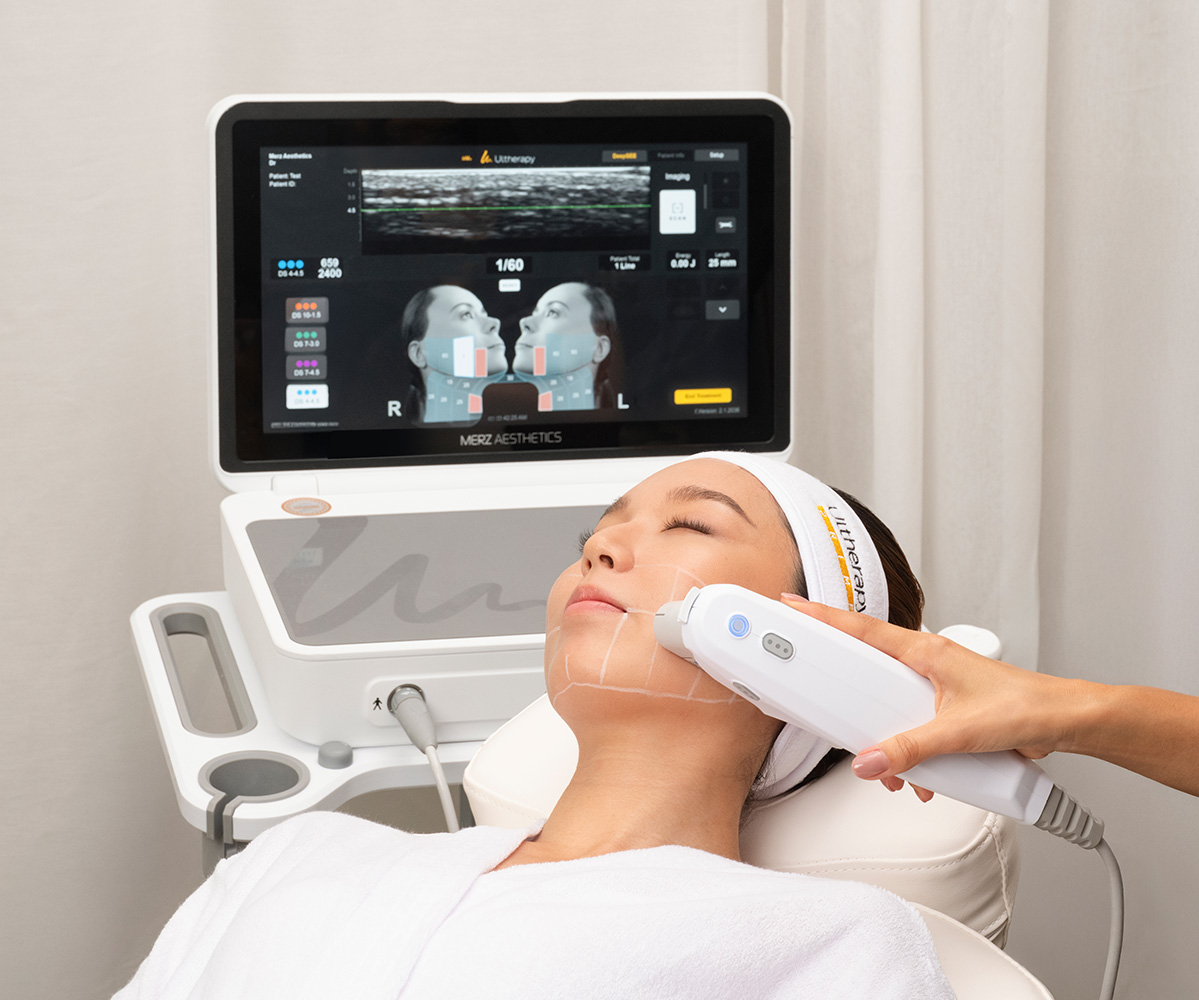
Ultherapy for Nasolabial Folds: Can It Improve Smile Lines Without Filler?
“Ultherapy made more of a difference around my smile lines than I expected.”
For many people considering non-surgical facial rejuvenation, the area around the mouth is one of the first places where age-related changes become noticeable.
The smile lines may appear deeper, the cheeks may look slightly lower, and the transition between the midface and jawline may become less defined.
Although dermal filler is commonly associated with nasolabial fold treatment, adding volume is not always the most appropriate solution.
Ultherapy offers a different approach by addressing selected concerns related to tissue firmness and skin laxity.
For suitable patients, this may also make the area around the mouth appear less heavy.
1. Why Do Nasolabial Folds Become Deeper With Age?
Nasolabial folds are the natural creases extending from the sides of the nose toward the corners of the mouth.
Their appearance can change over time due to several factors:
-
Reduced collagen and skin elasticity
-
Changes in facial fat compartments
-
Midface volume loss
-
Changes in underlying bone structure
-
Soft-tissue descent
-
Repeated facial expressions
Some people naturally have prominent smile lines even at a young age.
Others notice that their folds become progressively deeper as the surrounding facial tissues change.
Understanding these differences helps determine whether tightening, volume restoration or another treatment would be more appropriate.
2. Why Does the Mouth Area Sometimes Look Heavier?
Patients often describe changes around their mouths without necessarily referring to wrinkles.
They may notice that their lower cheeks look fuller, the corners of their mouths appear less defined, or their jawlines no longer look as sharp.
These concerns may be associated with early facial laxity.
When the surrounding tissues become less firm, shadows around the nasolabial folds and mouth corners may become more noticeable.
Adding filler directly into these areas may soften a crease, but it does not necessarily improve the underlying laxity.
3. How Does Ultherapy Work?
Ultherapy is a non-surgical treatment that uses microfocused ultrasound energy with visualization to target selected tissue layers beneath the skin.
The controlled thermal response stimulates collagen remodeling over time.
Depending on individual anatomy and treatment suitability, potential improvements may include:
-
Increased skin firmness
-
Improved lower-face contour
-
Reduced appearance of mild skin laxity
-
More defined jawline transitions
-
Gradual tissue tightening
Unlike dermal fillers, Ultherapy does not introduce a volumizing gel into the face.
This can make it an appealing option for patients who already have sufficient facial volume but are beginning to notice looseness.
4. Can Ultherapy Reduce Nasolabial Folds Without Adding Volume?
Ultherapy may indirectly improve the appearance of nasolabial folds when surrounding tissue laxity contributes to their prominence.
As the treated tissues gradually become firmer, some patients may notice that the transition between the cheeks and mouth looks smoother.
However, the degree of improvement varies.
Ultherapy does not directly replace lost facial fat or fill a deep structural crease. Patients with substantial midface volume loss may require a different treatment approach.
5. Who Is a Good Candidate for Ultherapy Around the Mouth?
Ultherapy may be worth considering for patients experiencing mild-to-moderate facial laxity, particularly when they notice:
-
Early signs of jowling
-
Reduced jawline definition
-
Looser skin around the lower cheeks
-
Increased heaviness around the mouth
-
Changes in facial firmness
-
More noticeable smile lines associated with laxity
Patients who already have sufficient facial volume but prefer to avoid additional filler may also find this treatment worth discussing.
However, people with significant skin excess or advanced tissue descent may require surgical evaluation to achieve their desired degree of correction.
6. Can Ultherapy Make You Look Younger Without Changing Your Facial Shape?
One reason some patients prefer Ultherapy is that it does not introduce additional filler volume.
Someone who already has naturally full cheeks may be concerned that adding dermal filler will make the face wider or heavier.
Ultherapy offers an alternative approach focused on tissue remodeling.
The improvement is generally gradual, allowing the patient to maintain familiar facial proportions while potentially improving selected areas of laxity.
Results vary, and unwanted changes in volume or contour are also possible.
7. Ultherapy vs Dermal Filler for Nasolabial Folds
The choice between Ultherapy and dermal filler depends largely on the underlying cause of the folds.
When Ultherapy May Be More Appropriate
Ultherapy may deserve consideration when the patient has adequate facial volume but is experiencing reduced firmness, early jowling or lower-face laxity.
When Dermal Filler May Be More Appropriate
Dermal filler may be considered when the primary concern is a structural depression or genuine loss of facial volume.
When Both Treatments May Be Considered
Some patients experience both tissue laxity and volume loss.
In these situations, a staged treatment plan may address firmness first and reassess whether additional volume restoration is necessary afterward.
This approach may help avoid treating every visible fold with unnecessary filler.
8. Ultherapy vs Thermage for Smile Lines
Both Ultherapy and Thermage are non-surgical energy-based treatments, but they use different technologies.
Ultherapy uses microfocused ultrasound with visualization to deliver energy to selected tissue depths.
Thermage FLX uses monopolar radiofrequency energy to heat tissue and stimulate collagen remodeling.
Both may be considered for selected skin laxity concerns, although their treatment characteristics differ.
For someone concerned about nasolabial folds, the choice should consider:
-
Skin thickness
-
Facial volume
-
Degree of laxity
-
Treatment area
-
Previous aesthetic procedures
-
Desired degree of improvement
Neither treatment should be expected to completely eliminate deep nasolabial folds.
9. How Long Does Ultherapy Take to Show Results?
Ultherapy works through a gradual tissue response.
While some patients notice early changes, improvements often become more apparent over approximately two to three months and may continue developing afterward.
This is different from dermal filler, which generally produces an immediate structural change.
Taking photographs before treatment and again several months later can help patients appreciate subtle changes that may otherwise be difficult to notice from day to day.
10. Are There Risks Associated With Ultherapy?
Although Ultherapy is non-surgical, it is not risk-free.
Potential temporary side effects include redness, swelling, tenderness, tingling and altered skin sensation.
Less common complications may include burns, prolonged numbness, temporary muscle weakness and unwanted changes in facial volume or contour.
Appropriate patient selection and treatment planning are particularly important for patients who already have a thin or hollow-looking face.
Persistent or worsening symptoms should be evaluated by the treating healthcare professional.
M Medi Spa Physicians’ Professional Recommendations
For patients considering Ultherapy for nasolabial folds, M Medi Spa recommends evaluating the relationship between facial volume and tissue laxity before selecting a treatment.
Assess Facial Volume Before Tightening
Patients with naturally thin faces or significant midface volume loss may require a different treatment strategy from those with fuller cheeks and mild laxity.
Evaluate the Entire Lower Face
The nasolabial folds should be considered alongside the cheeks, mouth corners, jawline and jowls.
Avoid Unnecessary Filler
When the main concern is tissue laxity, adding more facial volume may not provide the desired improvement.
Consider Previous Aesthetic Treatments
Previous filler, radiofrequency treatments and ultrasound-based procedures should be discussed during consultation.
Allow Time for Collagen Remodeling
Ultherapy results develop gradually. Additional treatments should be considered after an appropriate reassessment rather than judging the outcome immediately.
Real Client Experience
An illustrative client in her late 40s might notice that the area around her mouth has gradually become heavier, particularly in photographs taken from a three-quarter angle.
She initially considers nasolabial fold filler because her smile lines have become more noticeable.
During consultation, however, her cheeks appear to have adequate volume. Mild lower-face laxity appears to be contributing to the change.
An ultrasound-based tightening treatment is considered before adding any filler.
Over the following months, she notices a modest improvement in jawline definition and a softer transition between her cheeks and mouth.
Although her smile lines remain visible, she feels less concerned about them because the surrounding area no longer appears as heavy.
This is an illustrative scenario created for educational purposes. It is not a real M Medi Spa testimonial and does not guarantee a specific treatment outcome.
Why M Medi Spa Is Different From Other Clinics
M Medi Spa in Markham offers multiple aesthetic treatment options, including Ultherapy, Thermage FLX and dermal fillers.
Having different treatment technologies available allows the consultation to consider more than one approach to facial aging.
An individualized assessment may include facial volume, skin elasticity, lower-face laxity, nasolabial fold depth, jawline definition and previous injectable treatments.
For patients who prefer to avoid adding volume, non-surgical skin-tightening options may deserve consideration.
For others, conservative volume restoration may be more appropriate.
Treatment recommendations depend on individual anatomy, medical history and aesthetic goals.
Ultherapy vs Thermage vs Dermal Filler for Nasolabial Folds
| Feature | Ultherapy | Thermage FLX | Dermal Filler |
|---|---|---|---|
| Technology | Microfocused ultrasound | Monopolar radiofrequency | Injectable volumizing material |
| Primary purpose | Tissue lifting and tightening | Skin firming and tightening | Volume restoration |
| Collagen remodeling | Yes | Yes | Product-dependent |
| Adds facial volume | No | No | Yes |
| Directly fills smile lines | No | No | Can |
| Mild skin laxity | May improve | May improve | Limited benefit |
| Midface volume loss | Does not replace volume | Does not replace volume | May improve |
| Result development | Gradual | Gradual | Generally immediate |
| Surgical incisions | No | No | No |
| Treatment suitability | Individual assessment | Individual assessment | Individual assessment |
Frequently Asked Questions
1. Is Ultherapy good for nasolabial folds?
Ultherapy may improve the appearance of nasolabial folds in selected patients when skin laxity and surrounding tissue changes contribute to their prominence.
2. Can Ultherapy remove smile lines completely?
Complete removal should not be expected. Nasolabial folds are a normal anatomical feature, and Ultherapy does not directly fill them.
3. Can Ultherapy help sagging around the mouth?
It may improve selected mild-to-moderate skin laxity concerns, potentially making the lower face appear firmer and less heavy.
4. Is Ultherapy better than filler for smile lines?
Ultherapy may be more relevant when laxity is the primary concern, while filler may be appropriate when genuine volume loss contributes to the folds.
5. Can Ultherapy make my face thinner?
Ultherapy is not primarily a facial slimming treatment. Changes in tissue firmness may influence facial contour, but unwanted volume changes are also possible.
6. How long does Ultherapy take to improve the lower face?
Results often develop over two to three months, with further changes potentially occurring afterward. Individual responses vary.
7. Is Thermage or Ultherapy better for nasolabial folds?
Both may be considered for selected laxity concerns. The appropriate technology depends on facial anatomy, skin condition and treatment goals.
8. Can I combine Ultherapy with dermal filler?
Yes, when clinically appropriate. Treatment timing and sequencing should account for previous filler, treatment areas and individual anatomy.
9. Can Ultherapy replace a facelift?
No. Ultherapy may provide modest non-surgical lifting and tightening benefits, but it cannot reproduce the degree of tissue repositioning achieved through surgery.
10. Do I need Ultherapy every year?
There is no universal maintenance schedule. Repeat treatment should depend on the patient’s response, current skin condition and professional reassessment.
Visit M Medi Spa in Markham
If you are looking for Ultherapy for nasolabial folds in Markham or Toronto, an individualized consultation can help determine whether your smile lines are primarily associated with skin laxity, facial volume loss or a combination of both.
M Medi Spa offers aesthetic treatment options for patients interested in non-surgical facial rejuvenation, skin tightening and natural-looking improvements in facial contour.
M Medi Spa
Address: 8130 Birchmount Rd #26-27, Markham, ON L6G 0E3
Phone: +1 905-470-2998
Service Features
-
Physician-guided assessment
-
Ultherapy ultrasound skin tightening
-
Thermage FLX radiofrequency treatment
-
Individualized facial rejuvenation consultation
-
Nasolabial fold assessment
-
Lower-face and jawline evaluation
-
Facial volume loss assessment
-
Non-surgical treatment options
-
Personalized treatment planning
-
Individualized follow-up