
Natural Looking Dermal Fillers Should Pass the “Face in Motion” Test
Seeing your dermal filler before-and-after photographs can be exciting.
Perhaps your cheeks suddenly look more balanced. Your under-eye transition appears smoother. Your lips have better definition. Or your entire face simply looks fresher than it did before treatment.
You may look at the photographs and think:
“I’m blown away.”
But there is another question worth asking:
“What does the filler look like when I smile, talk, laugh, or make normal facial expressions?”
That question gets to the heart of natural looking dermal fillers.
A face is not a still photograph. During a normal conversation, dozens of muscles and soft-tissue structures work together. The cheeks rise, lips stretch and compress, folds deepen, eyes narrow, and the lower face constantly changes shape.
A result that looks excellent in one carefully positioned photograph should ideally remain harmonious when the face starts moving.
For patients seeking subtle aesthetic treatment, this dynamic appearance can be just as important as the traditional before-and-after image.
Why Can Filler Look Different When You Smile?
The face behaves very differently at rest and during expression.
Cheeks Rise During a Smile
When someone smiles, the midface moves upward. This temporarily changes cheek projection and the appearance of surrounding tissues.
If substantial volume has been added to the cheeks, the effect may appear different during a broad smile than it does while the patient is resting.
The Lips Constantly Change Shape
Lips move during:
- Talking
- Smiling
- Laughing
- Eating
- Pursing
- Kissing
This makes lip filler particularly dependent on dynamic facial balance.
Facial Folds Are Supposed to Move
Nasolabial folds and other facial lines naturally become more visible during expression.
Trying to eliminate every fold at rest may sometimes create unnecessary fullness when the patient smiles.
Natural facial movement should therefore be considered part of aesthetic treatment planning.
Why Before-and-After Filler Photos Don’t Tell the Whole Story
Before-and-after photographs remain valuable.
They can help document changes in:
- Volume
- Symmetry
- Facial contours
- Proportions
- Shadows
- Profile balance
But photographs capture only one fraction of a second.
Lighting, facial expression, camera distance, angle, and head position can also affect how dramatic the change appears.
Someone may therefore have an impressive static result while noticing something different during conversation or smiling.
This doesn’t mean before-and-after photography is misleading. It means photographs are only one part of evaluating an aesthetic result.
What Makes Dermal Filler Look Unnatural in Motion?
There is rarely one single cause.
Several factors may contribute.
Too Much Volume for the Individual Face
More filler does not automatically produce a better result.
If added volume exceeds what naturally suits the patient’s anatomy, it may become particularly noticeable during movement.
Treating Individual Features Without Considering the Whole Face
A cheek, lip, or chin does not exist independently.
Changing one feature can influence how nearby structures appear.
Trying to Remove Every Natural Fold
Normal faces have folds when they smile.
The goal of aesthetic treatment should not necessarily be a perfectly smooth, motionless surface.
Repeated Filler Without Reassessment
A patient may gradually receive additional filler over several appointments.
If existing volume is not reassessed first, facial proportions can slowly change.
Following a Trend Instead of Anatomy
A treatment technique that produces attractive results on one face may look completely different on another.
Natural Looking Dermal Fillers and the “Less Is More” Philosophy
The idea that less is more doesn’t mean every patient should receive the smallest possible amount of filler.
It means treatment should stop when the desired balance has been achieved.
The appropriate amount depends on:
- Natural bone structure
- Existing facial volume
- Age-related changes
- Skin quality
- Previous treatments
- Treatment area
- Desired result
A patient with significant structural volume loss may require a different strategy from someone seeking a tiny refinement.
The key is appropriate volume, not maximum volume.
Where Is Facial Movement Especially Important?
Lip Filler
Lip treatment should account for the patient’s natural smile and speech patterns.
Beautiful lips should ideally remain proportionate whether the mouth is relaxed or moving.
Cheek and Midface Filler
Cheeks become more prominent during smiling.
Treatment planning should consider how added support interacts with this natural movement.
Nasolabial Fold Filler
Smile lines deepen during expression because that’s what they’re anatomically designed to do.
Completely erasing them at rest is not always an appropriate goal.
Chin and Lower-Face Filler
The lower face changes during speech and facial expressions, so chin and jawline enhancement should remain balanced with surrounding structures.
Can You Have Filler That Nobody Notices?
Yes—that is actually the goal for many patients.
Someone may notice:
“You look rested.”
“You look really good lately.”
“Did you change your skincare?”
They may recognize an improvement without identifying filler as the reason.
That is different from making the treatment literally invisible.
Rather, the enhancement blends into the patient’s existing features so naturally that it doesn’t immediately announce itself as a cosmetic procedure.
M Medi Spa Physicians’ Professional Recommendations
The physician team at M Medi Spa believes that natural looking dermal fillers should be evaluated in real-life facial movement, not only through static photographs.
Evaluate the Face at Rest and in Motion
Before creating a treatment plan, observing how the patient smiles and speaks can reveal information that isn’t obvious in a neutral photograph.
Treat the Person, Not the Before-and-After Picture
The goal should not be producing the most dramatic image possible.
Patients need results that work during daily conversations, photographs, work, social events, and natural expressions.
Don’t Eliminate Normal Anatomy
Facial lines and folds are not automatically defects.
A smiling face naturally has movement and texture.
Reassess Before Adding More Filler
If a patient already has filler, current facial volume should be evaluated before additional treatment is recommended.
Use Conservative Volume Strategically
Sometimes a small structural adjustment creates more aesthetic improvement than broadly adding volume across several areas.
Preserve Facial Identity
A successful treatment should enhance recognizable features rather than gradually replace them with a standardized filler look.
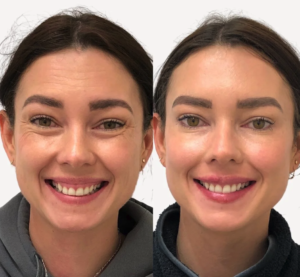
Real Client Experience: The Result Looked Great in Photos—but She Wanted to Check Her Smile
A client visited M Medi Spa seeking subtle midface rejuvenation.
She had seen numerous before-and-after filler photographs online and loved many of the transformations. At the same time, she had also seen videos in which facial filler seemed far more noticeable when people smiled or spoke.
Her goal was very clear:
She wanted to look refreshed without changing the way her face naturally moved.
During her physician-guided consultation, her face was evaluated at rest and during normal expressions.
Instead of creating dramatic cheek projection, the treatment discussion focused on restoring subtle balance that complemented her natural anatomy.
After treatment and healing, she initially loved the before-and-after photographs.
Then she did something even more important.
She talked, laughed, smiled broadly, and watched her facial expressions.
Her cheeks still moved naturally. Her smile still looked recognizable. She simply felt that her face appeared more refreshed.
Friends noticed she looked good but didn’t immediately ask whether she had received filler.
For her, that became more meaningful than the still photograph.
The treatment didn’t just photograph well—it lived well on her face.
Why M Medi Spa Is Different From Other Clinics
Patients searching for natural looking dermal fillers may not want the biggest possible transformation.
They often want something much more difficult to achieve:
A noticeable improvement that does not look obviously treated.
Dynamic Facial Assessment
M Medi Spa considers facial movement alongside static anatomy when appropriate.
The patient is not simply a still image.
Physician-Guided Treatment Planning
Recommendations begin with facial assessment rather than automatically assigning a particular number of syringes.
Conservative Enhancement Philosophy
The objective is not maximum volume.
Treatment is designed around what complements the patient’s existing facial structure.
Previous Filler Is Considered
Patients returning for additional treatment can have their current facial volume reassessed before more product is recommended.
Facial Balance Over Isolated Features
Rather than treating each cheek, wrinkle, or lip independently, the broader relationship between facial structures is considered.
Natural Expression Matters
The goal is a face that remains recognizable and harmonious while smiling, talking, and laughing—not merely one that looks good in a posed photograph.
Should You Take Videos Before and After Dermal Filler?
For patients especially concerned about dynamic results, personal videos may offer another useful reference.
Before treatment, you might record yourself naturally:
- Talking
- Smiling
- Laughing
- Turning your head
- Relaxing your face
The objective isn’t to analyze every millisecond of movement.
Faces are naturally asymmetrical. They fold. They wrinkle. One side may move slightly differently from the other.
Those characteristics are normal.
A short video simply provides another way to remember how your expressions looked before treatment.
Does Natural Filler Mean Your Face Should Never Look Different in Motion?
No.
Every face changes dramatically between rest and expression—with or without filler.
When you smile:
- Cheeks rise
- Eye areas compress
- Nasolabial folds deepen
- Lips stretch
- Chin and jaw muscles move
The goal isn’t to stop those changes.
Natural-looking filler should ideally work with normal movement rather than making normal movement appear unusual.
Why Social Media Can Distort Expectations About Filler
A dramatic static transformation often receives more attention online than a subtle change.
This can create two misleading impressions.
First, people may believe fillers always need to produce a dramatic transformation.
Second, they may assume every attractive person with balanced facial features naturally looks that way without any aesthetic treatment.
In reality, subtle treatments may simply be less recognizable.
That’s one reason judging cosmetic work solely from social-media photographs can be difficult.
How Can You Avoid an Overfilled Appearance?
A few principles are especially useful:
- Choose a provider focused on facial anatomy rather than trends
- Communicate that you want subtle results
- Consider facial movement during assessment
- Avoid automatically treating every visible line
- Reassess existing filler before adding more
- Allow treatment to settle before deciding you need additional volume
- Evaluate the entire face instead of one isolated feature
Most importantly, remember that more correction is not always more attractive.
Sometimes stopping is part of good treatment planning.
Natural Dermal Filler vs Overfilled Results
| Natural Treatment Goal | Potential Overcorrection Concern |
|---|---|
| Preserve facial identity | Change recognizable features |
| Maintain normal expressions | Focus only on the resting face |
| Restore appropriate support | Maximize volume |
| Respect normal smile lines | Attempt to erase every fold |
| Assess existing filler | Automatically add more |
| Enhance individual anatomy | Copy social-media trends |
| Look refreshed | Look obviously “filled” |
The difference isn’t determined by one syringe number.
It’s determined by the complete treatment strategy.
Frequently Asked Questions About Natural Looking Dermal Fillers
1. Should filler look natural when I smile?
A thoughtfully planned treatment should aim to remain harmonious with the patient’s normal facial expressions, although every face naturally changes shape during smiling.
2. Why does filler sometimes look more obvious in motion?
Facial muscles move the surrounding soft tissues during speech and expression, which can change how added volume appears.
3. Can dermal filler look amazing in a photo but different in real life?
Yes. Static photographs capture one position and angle, while real-life facial movement is continuous.
4. Does using less filler always create more natural results?
Not automatically. The appropriate amount depends on anatomy, treatment area, existing volume, previous filler, and the patient’s goals.
5. How can I tell my injector that I want subtle filler?
Explain that you want to look refreshed while preserving your recognizable features and natural facial expressions.
6. Should an injector look at my face while I’m smiling?
Observing dynamic facial movement can provide additional information during treatment planning, particularly when the patient’s concern changes significantly with expression.
7. How can I avoid looking overfilled?
Conservative planning, reassessing previous filler, allowing adequate time between treatments, and treating facial balance rather than repeatedly adding volume can all help.
8. Are before-and-after pictures enough to judge filler results?
They are useful, but they don’t show every aspect of a result. Facial movement, multiple angles, healing, and how the patient looks in everyday life also matter.
Visit M Medi Spa in Markham
If you’re interested in natural looking dermal fillers, M Medi Spa offers physician-guided consultations focused on creating facial rejuvenation that works with your individual anatomy and natural expressions.
M Medi Spa
Address:
8130 Birchmount Rd #26-27
Markham, ON L6G 0E3
Phone:
+1 905-470-2998
Service Features
- Physician-guided dermal filler consultations
- Personalized facial anatomy assessments
- Static and dynamic facial evaluation
- Conservative filler treatment planning
- Natural-looking facial rejuvenation
- Facial balancing consultations
- Previous filler assessment
- Customized treatment strategies
- Personalized aftercare guidance
- Long-term aesthetic planning
- Modern medical spa environment in Markham